⸺ 01 The neurobiology

Four convergent physiological realities.

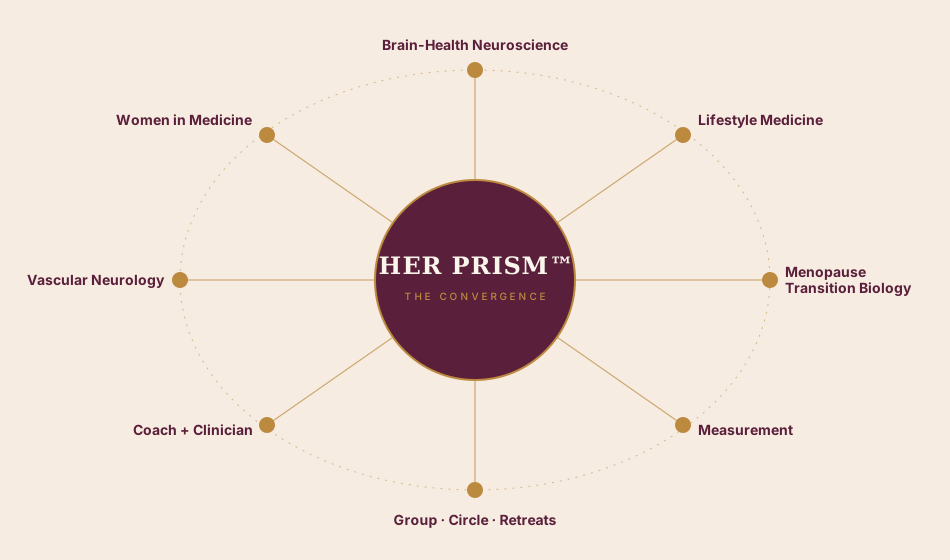
The HER PRISM Method™ is informed by four overlapping realities documented across the burnout, stress, and menopause transition literatures. None are metaphors. Each is real. Each is supported through the educational and coaching work of the program.

01

Cumulative stress load

The cumulative biological cost of years of chronic stress. The program supports realignment through nervous-system regulation, sleep restoration, and lifestyle medicine education.

02

Autonomic and stress-axis rhythms

After years of high demand, the body’s stress and recovery rhythms can drift — cortisol patterns, sleep architecture, and the curve of recovery itself. Supportable through education and coaching practice.

03

Natural brain remodeling during the menopause transition

The menopause transition is a window of natural neurobiological shift — affecting attention, working memory, and how the brain manages load. The shifts are normal. The work supports you through them.

⸺ 02 Frameworks built into the method

Evidence-based scaffolding.

HER PRISM™ layers the strongest empirical frameworks across positive psychology, behaviour change, and lifestyle medicine. The core anchors:

See the full framework set on the Method page →

⸺ 03 Validated outcome measurement

Progress is observed, not inferred.

Every cohort completes validated outcome instruments at intake, mid-program, and Week 16 — so change is documented rather than assumed. Members see their own change against published norms, not a coach’s testimonial.

The instruments cover sleep quality, burnout, character strengths, and the proprietary HER PRISM Self-Assessment™ — which examines lifestyle, work, relationships, and the menopause transition. Optional add-ons include HRV tracking and a human design assessment. Each is administered at intake, mid-program, and Week 16.

⸺ 04 Featured in peer-reviewed manuscripts

Selected publications.

Menopause · May 2026 · Personal Perspective

When Biology Meets Burnout: Retaining Midcareer Women in Academic Medicine

Pikula A. et al. — the case for meeting burnout in midlife women in medicine as a convergent biological reality, and the structural workforce implications of doing so.

Stroke · 2026

Midlife as the Critical Window for Women’s Stroke and Dementia Prevention

Pikula A. et al. — pivotal advances and implementation priorities, situating midlife as the decisive prevention window for women’s cerebrovascular and cognitive health.

⸺ 05 Needs assessment · March 2026 · n = 112

What 112 women in medicine told us.

Attending physicians, residents, fellows, academic faculty, NPs, and allied health professionals completed a comprehensive needs assessment for the Feel You Again™ program.

53%
Sleep disruption
Co-led with cognitive fog (53%) — biologically downstream of HPA dysregulation.
80%
Tried lifestyle, exercise, nutrition — and still depleted
53% tried therapy. 40% restructured schedules. Most cited reason it didn’t resolve: “not designed for women in medicine.”
83%
Want confidence to set boundaries and lead
The single highest outcome finding across all questions. The existentially depleted are asking to be reconstructed.
43–50%
Report guilt — identical regardless of stage in the menopause transition
Confirmed structural, not hormonal. The intersection of medical socialization, gender-role expectation, and institutional under-resourcing.

Two distinct presentations — not one.

The Biologically Depleted (40%) — clinical, in the menopause transition. Sleep and fog at 67%. Biological recovery is the top priority (83%). Cynicism appears at 33% — only in this group. She is asking to be restored.

The Existentially Depleted (40%) — clinical, not in menopause. Lower symptom burden but the highest confidence deficit in the survey. Cynicism is 0%; her dopaminergic reward circuitry is intact. She is asking to be reconstructed.

The two groups diverge by up to 83 percentage points on individual variables. No single-modality program satisfies a cohort whose needs span physical, behavioural, and existential domains simultaneously. The architecture has to be integrated.

Source: HER PRISM · Feel You Again™ Program Needs Assessment, March 2026. n = 112 women in medicine. Multi-select questions; percentages may exceed 100%. Comprehensive Survey Report available on request.

⸺ 06 Outcomes & Cohort 1

Realignment, measured. The science is real.

Outcomes from Cohort 1 will be measured using the validated instruments above and reported here in aggregate, de-identified form once the cohort completes Week 16. Cohort 1 of Feel You Again™ is forming — starting Fall 2026.

Join the Cohort 1 waitlist →