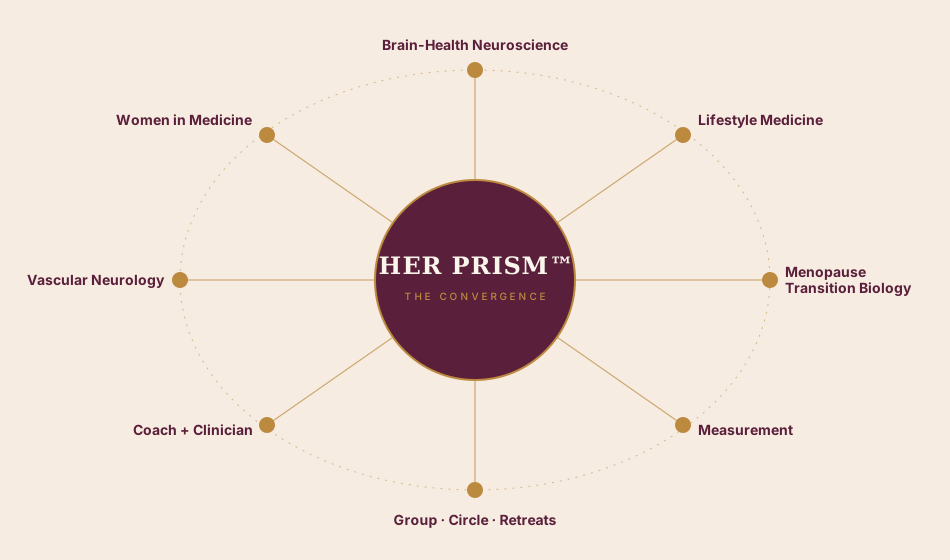
Every protocol, exercise, and instrument in the program is grounded in peer-reviewed literature or validated outcome measurement. Burnout in midlife women in medicine is a measurable, reversible neurobiological condition — and that is how we treat it.
The HER PRISM Method™ targets four overlapping mechanisms documented across the burnout, stress, and perimenopause literatures. None of these are metaphors. Each is measurable, and each is a target of specific protocols within the program.
The cumulative biological cost of chronic stress adaptation, including elevated cortisol, blood pressure, and inflammatory markers. Reversible through structured nervous-system regulation, sleep restoration, and lifestyle medicine.
Disruption of the hypothalamic-pituitary-adrenal axis after years of chronic stress, presenting as flattened or inverted cortisol rhythms, sleep architecture changes, and altered stress recovery curves.
Documented structural and functional changes under prolonged stress affecting executive function, working memory, and decision-making. Partially reversible through behavioural and lifestyle intervention.
Declining and fluctuating estradiol, progesterone, and follicle-stimulating hormone shifts directly affect mood neurochemistry, sleep architecture, vasomotor stability, and cognition. These are not "in your head" — they are a measurable, scheduled neurochemical event that compounds with chronic stress in clinically predictable ways. The program is designed for this convergence specifically.
HER PRISM™ layers the strongest empirical frameworks across positive psychology, behaviour change, and lifestyle medicine. Each is integrated into specific modules and exercises.
| Framework | Role in the program | Module |
|---|---|---|
| PERMA — Seligman | The five-domain model of wellbeing (positive emotion, engagement, relationships, meaning, accomplishment) is used to schedule recovery into a real week. | Module 3 (Reclaim) |
| VIA Character Strengths — Peterson & Seligman | The most evidence-supported strengths inventory in positive psychology. Used to anchor values archaeology and PERMA scheduling. | Module 3 (Reclaim) |
| Self-Determination Theory — Deci & Ryan | Autonomy, competence, and relatedness as the three psychological nutrients of sustained behaviour change. Applied to why every previous attempt failed. | Module 4 (Sustain) |
| Implementation intentions — Gollwitzer | "If-then" planning that converts intention into automatic behaviour. The mechanism behind Boundary Architecture and the Morning Protocol. | Module 4 (Sustain) |
| Habit stacking — Clear / behavioural science | Anchoring new practices to existing routines so they survive a real medical schedule. | Module 4 (Sustain) |
| Broaden-and-Build — Fredrickson | The neurobiological case for cultivating positive affect as a recovery mechanism, not a luxury. | Module 3 (Reclaim) |
| PREDIMED trial findings | Large randomized evidence on Mediterranean nutritional patterns and cognitive protection. Underpins the nutrition foundations module. | Module 2 (Reset) |
| Lifestyle medicine pillars | Six-pillar evidence base for non-pharmacological intervention across nutrition, movement, sleep, stress, social connection, and substance use. | Module 2 & 4 |
Every cohort completes validated outcome instruments at intake, mid-program, and Week 16 — so change is documented rather than assumed. Members can see their own change against published norms, not a coach's testimonial.
"When Biology Meets Burnout: Retaining Midcareer Women in Academic Medicine"
Menopause, 2026. The manuscript articulates the clinical case for treating burnout in midlife women in medicine as a convergent neurobiological event — and the structural workforce implications of doing so.
"Midlife as the Critical Window for Women's Stroke and Dementia Prevention: Pivotal Advances and Implementation Priorities"
Stroke, 2026. The paper situates midlife as the decisive prevention window for women's cerebrovascular and cognitive health — and translates the evidence into implementation priorities for clinicians, systems, and the women themselves.
In March 2026, 112 women in medicine — attending physicians, residents, fellows, academic faculty, nurse practitioners, and allied health professionals — completed a comprehensive needs assessment for the Feel You Again™ program. The findings sit alongside the peer-reviewed manuscripts above as the empirical case for the architecture HER PRISM™ was built to provide.
Sleep disruption (53%) and cognitive fog (53%) co-led the symptom profile — both biologically downstream of HPA axis dysregulation and declining estrogen. Forty percent rated themselves at moderate-to-significant depletion. These are not lifestyle complaints. They are the neurobiological signal of a population working under sustained allostatic load.
Eighty percent had tried exercise, nutrition, and lifestyle. Fifty-three percent had tried therapy. Forty percent had restructured their schedules. The most cited reason none of it resolved the depletion: "not designed for women in medicine" (33%). The mechanism is mechanistically clear — generic programs do not address physician-specific allostatic load, do not redesign career architecture, and do not name the systemic forces generating the depletion.
When the cohort was crossed by clinical role and menopausal status, two near-equal groups emerged — each representing 40% of respondents — diverging by up to 83 percentage points on individual variables.
Across both groups, 43–50% report guilt — identical across menopausal status. The cross-cell confirmation that guilt in this population is produced by the intersection of medical socialization, gender-role expectation, and chronic institutional under-resourcing. Not by hormones. Not by character.
A concrete plan for the next career chapter (67%). Sustainable brain-protective habits (60%). Restored physical energy and cognitive sharpness (47%). Clarity on values (47%). Safe peer community with women who share the specific experience of medicine (40%). Hybrid delivery (40%), three to six months in length, evening or asynchronous timing, and clinically sophisticated content. No single-modality program satisfies a cohort whose needs span physical, behavioural, and existential domains simultaneously. The architecture has to be integrated.
Source: HER PRISM · Feel You Again™ Program Needs Assessment, March 2026. n = 112 women in medicine. Multi-select questions permit more than one response per respondent; those percentages may exceed 100%. All subgroup comparisons are descriptive. Comprehensive Survey Report available on request.
Cohort 1 is the founding cohort. Outcomes from this group will be measured using the same validated instruments described above and reported in aggregate form on this page once the cohort completes Week 16.
Aggregate, de-identified results — including pre/post change on PSQI, MBI, and the HER PRISM Self-Assessment™ — will be published here once Cohort 1 completes the program.